A binary operation on a set \(G\) is a function \(G \times G \rightarrow G\text{,}\) written \((a,b) \mapsto ab\text{.}\) A group \((G, \cdot)\) is a set \(G\) with a binary operation satisfying:
Associativity: \((ab)c = a(bc)\) for all \(a, b, c \in G\text{.}\)
If, in addition, \(ab = ba\) for all \(a, b \in G\text{,}\) we call \(G\) abelian; otherwise \(G\) is nonabelian. The identity and every inverse are unique, by the same cancellation arguments used for rings and fields. A group is finite if it has finitely many elements, in which case \(|G|\) denotes its order, the number of elements it contains.
The integers \({\mathbb Z}\) form an abelian group under addition, with identity \(0\) and inverse \(-n\text{.}\) More generally, the underlying additive structure \((R, +)\) of any ring \(R\) is an abelian group; this is exactly the first four ring axioms. The integers mod \(n\text{,}\)\({\mathbb Z}_n = \{0, 1, \ldots, n-1\}\text{,}\) form an abelian group of order \(n\) under addition modulo \(n\text{,}\) with identity \(0\) and inverse \(n - a\) for \(a \neq 0\text{.}\)
If \(F\) is a field, its nonzero elements \(F^{\ast} = F \setminus \{0\}\) form an abelian group under multiplication, with identity \(1\) and inverse \(a^{-1}\) for each nonzero \(a\text{,}\) since every nonzero element of a field is a unit. Multiplication is closed on \(F^{\ast}\) because a field has no zero divisors: if \(ab = 0\) and \(a \neq 0\text{,}\) then \(b = a^{-1}(ab) = a^{-1} 0 = 0\text{.}\) This gives us the groups \({\mathbb Q}^{\ast}\text{,}\)\({\mathbb R}^{\ast}\text{,}\) and \({\mathbb C}^{\ast}\text{.}\)
Let \(GL_2({\mathbb R})\) be the set of invertible \(2 \times 2\) real matrices, with matrix multiplication as the operation. The identity is the identity matrix, and
\begin{equation*}
A =
\begin{pmatrix}
a & b \\
c & d
\end{pmatrix}
\qquad
A^{-1} =
\frac{1}{ad-bc}
\begin{pmatrix}
d & -b \\
-c & a
\end{pmatrix}
\end{equation*}
exists exactly when \(\det A = ad - bc \neq 0\text{.}\) Since matrix multiplication is not commutative, \(GL_2({\mathbb R})\text{,}\) the general linear group, is our first example of a nonabelian group.
A permutation of a set \(X\) is a bijection \(\pi : X \rightarrow X\text{.}\) Under composition, the permutations of \(X\) form a group; when \(X = \{1, \ldots, n\}\) this is the symmetric group \(S_n\text{.}\)
The identity map is the identity element, and every permutation has an inverse since it is a bijection. Composition of functions is always associative. That \(|S_n| = n!\) is left as an exercise.
A second family of permutation groups comes from symmetry. For \(n \geq 3\text{,}\) the rigid motions of a regular \(n\)-gon, acting on its \(n\) labeled vertices, form the dihedral group \(D_n \subset S_n\text{.}\)
\(D_n\) has order \(2n\text{.}\) It is generated by a rotation \(r\) of order \(n\) and a reflection \(s\) of order \(2\text{,}\) subject to the relation \(srs = r^{-1}\text{,}\) so that
A rigid motion sends the first vertex to any of the \(n\) vertices, and then the second vertex to one of its two neighbors, giving at most \(2n\) motions: the \(n\) rotations \(1, r, \ldots, r^{n-1}\) and the \(n\) reflections \(s, rs, \ldots, r^{n-1}s\text{.}\) All \(2n\) occur, so \(|D_n| = 2n\text{.}\)
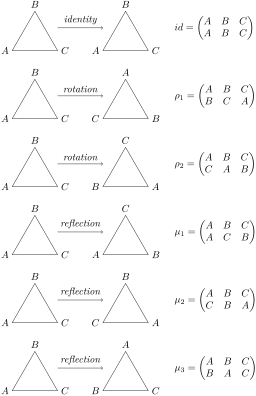
The equilateral triangle has \(3! = 6\) permutations of its vertices, and every one of them is realized by a rigid motion (Figure 7.1.6). So its symmetry group is all of \(S_3\text{,}\) and also \(D_3\text{:}\)\(S_3 = D_3\text{,}\) generated by a \(120^{\circ}\) rotation \(r\) and a reflection \(s\text{.}\) Composition here is not commutative, since reflecting then rotating a triangle is not the same as rotating then reflecting; \(S_3\) is our smallest nonabelian group.