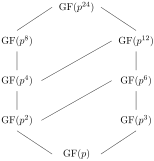
Recall that a field \(F\) has characteristic \(p\) if \(p\) is the smallest positive integer such that for every nonzero element \(\alpha\) in \(F\text{,}\) we have \(p \alpha = 0\text{.}\) If no such integer exists, then \(F\) has characteristic \(0\text{.}\) From Theorem 1.2.8 we know that \(p\) must be prime. Suppose that \(F\) is a finite field with \(n\) elements. Then \(n \alpha = 0\) for all \(\alpha\) in \(F\text{.}\) Consequently, the characteristic of \(F\) must be \(p\text{,}\) where \(p\) is a prime dividing \(n\text{.}\) This discussion is summarized in the following proposition.
Let \(\phi : {\mathbb Z} \rightarrow F\) be the ring homomorphism defined by \(\phi(n) = n \cdot 1\text{.}\) Since the characteristic of \(F\) is \(p\text{,}\) the kernel of \(\phi\) must be \(p {\mathbb Z}\) and the image of \(\phi\) must be a subfield of \(F\) isomorphic to \({\mathbb Z}_p\text{.}\) We will denote this subfield by \(K\text{.}\) Since \(F\) is a finite field, it must be a finite extension of \(K\) and, therefore, an algebraic extension of \(K\text{.}\) Suppose that \([F : K] = n\) is the dimension of \(F\text{,}\) where \(F\) is a \(K\) vector space. There must exist elements \(\alpha_1, \ldots, \alpha_n \in F\) such that any element \(\alpha\) in \(F\) can be written uniquely in the form
where the \(a_i\)’s are in \(K\text{.}\) Since there are \(p\) elements in \(K\text{,}\) there are \(p^n\) possible linear combinations of the \(\alpha_i\)’s. Therefore, the order of \(F\) must be \(p^n\text{.}\)
We will prove this lemma using mathematical induction on \(n\text{.}\) We can use the binomial formula (see Example B.1.4) to verify the case for \(n = 1\text{;}\) that is,
must be divisible by \(p\text{,}\) since \(p\) cannot divide \(k!(p - k)!\text{.}\) Note that \(D\) is an integral domain of characteristic \(p\text{,}\) so all but the first and last terms in the sum must be zero. Therefore, \((a + b)^p = a^p + b^p\text{.}\)
Let \(F\) be a field. A polynomial \(f(x) \in F[x]\) of degree \(n\) is separable if it has \(n\) distinct roots in the splitting field of \(f(x)\text{;}\) that is, \(f(x)\) is separable when it factors into distinct linear factors over the splitting field of \(f\text{.}\) An extension \(E\) of \(F\) is a separable extension of \(F\) if every element in \(E\) is the root of a separable polynomial in \(F[x]\text{.}\)
The polynomial \(x^2 - 2\) is separable over \({\mathbb Q}\) since it factors as \((x - \sqrt{2}\, )(x + \sqrt{2}\, )\text{.}\) In fact, \({\mathbb Q}(\sqrt{2}\, )\) is a separable extension of \({\mathbb Q}\text{.}\) Let \(\alpha = a + b \sqrt{2}\) be any element in \({\mathbb Q}(\sqrt{2}\, )\text{.}\) If \(b = 0\text{,}\) then \(\alpha\) is a root of \(x - a\text{.}\) If \(b \neq 0\text{,}\) then \(\alpha\) is the root of the separable polynomial
\begin{equation*}
x^2 - 2 a x + a^2 - 2 b^2 = (x - (a + b \sqrt{2}\, ))(x - (a - b \sqrt{2}\, ))\text{.}
\end{equation*}
Let \(f(x)\) be separable. Then \(f(x)\) factors over some extension field of \(F\) as \(f(x) = (x - \alpha_1) (x - \alpha_2) \cdots (x - \alpha_n)\text{,}\) where \(\alpha_i \neq \alpha_j\) for \(i \neq j\text{.}\) Taking the derivative of \(f(x)\text{,}\) we see that
To prove the converse, we will show that the contrapositive of the statement is true. Suppose that \(f(x) = (x - \alpha)^k g(x)\text{,}\) where \(k \gt 1\text{.}\) Differentiating, we have
\begin{equation*}
f'(x) = k ( x - \alpha)^{k-1} g(x) + (x- \alpha)^k g'(x)\text{.}
\end{equation*}
Therefore, \(f(x)\) and \(f'(x)\) have a common factor.
For every prime \(p\) and every positive integer \(n\text{,}\) there exists a finite field \(F\) with \(p^n\) elements. Furthermore, any field of order \(p^n\) is isomorphic to the splitting field of \(x^{p^n} -x\) over \({\mathbb Z}_p\text{.}\)
Let \(f(x) = x^{p^n} - x\) and let \(F\) be the splitting field of \(f(x)\text{.}\) Then by Lemma 6.1.5, \(f(x)\) has \(p^n\) distinct zeros in \(F\text{,}\) since \(f'(x) = p^n x^{p^n - 1} - 1 = -1\) is relatively prime to \(f(x)\text{.}\) We claim that the roots of \(f(x)\) form a subfield of \(F\text{.}\) Certainly 0 and 1 are zeros of \(f(x)\text{.}\) If \(\alpha\) and \(\beta\) are zeros of \(f(x)\text{,}\) then \(\alpha + \beta\) and \(\alpha \beta\) are also zeros of \(f(x)\text{,}\) since \(\alpha^{p^n} + \beta^{p^n} = (\alpha + \beta)^{p^n}\) and \(\alpha^{p^n} \beta^{p^n} = (\alpha \beta)^{p^n}\text{.}\) We also need to show that the additive inverse and the multiplicative inverse of each root of \(f(x)\) are roots of \(f(x)\text{.}\) For any zero \(\alpha\) of \(f(x)\text{,}\) we know that \(-\alpha\) is also a zero of \(f(x)\text{,}\) since
If \(\alpha \neq 0\text{,}\) then \((\alpha^{-1})^{p^n} = (\alpha^{p^n})^{-1} = \alpha^{-1}\text{.}\) Since the zeros of \(f(x)\) form a subfield of \(F\) and \(f(x)\) splits in this subfield, the subfield must be all of \(F\text{.}\)
Let \(E\) be any other field of order \(p^n\text{.}\) To show that \(E\) is isomorphic to \(F\text{,}\) we must show that every element in \(E\) is a root of \(f(x)\text{.}\) Certainly 0 is a root of \(f(x)\text{.}\) Let \(\alpha\) be a nonzero element of \(E\text{.}\) The order of the multiplicative group of nonzero elements of \(E\) is \(p^n-1\text{;}\) hence, \(\alpha^{p^n-1} =1\) or \(\alpha^{p^n} -\alpha = 0\text{.}\) Since \(E\) contains \(p^n\) elements, \(E\) must be a splitting field of \(f(x)\text{;}\) however, by Corollary 5.2.8, the splitting field of any polynomial is unique up to isomorphism.
Every subfield of the Galois field \(\gf(p^n)\) has \(p^m\) elements, where \(m\) divides \(n\text{.}\) Conversely, if \(m \mid n\) for \(m \gt 0\text{,}\) then there exists a unique subfield of \(\gf(p^n)\) isomorphic to \(\gf(p^m)\text{.}\)
Let \(F\) be a subfield of \(E = \gf(p^n)\text{.}\) Then \(F\) must be a field extension of \(K\) that contains \(p^m\) elements, where \(K\) is isomorphic to \({\mathbb Z}_p\text{.}\) Then \(m \mid n\text{,}\) since \([E:K] = [E:F][F:K]\text{.}\)
To prove the converse, suppose that \(m \mid n\) for some \(m \gt 0\text{.}\) Then \(p^m -1\) divides \(p^n -1\text{.}\) Consequently, \(x^{p^m -1} - 1\) divides \(x^{p^n -1} -1\text{.}\) Therefore, \(x^{p^m} - x\) must divide \(x^{p^n} - x\text{,}\) and every zero of \(x^{p^m} - x\) is also a zero of \(x^{p^n} - x\text{.}\) Thus, \(\gf(p^n)\) contains, as a subfield, a splitting field of \(x^{p^m} - x\text{,}\) which must be isomorphic to \(\gf(p^m)\text{.}\)