\begin{equation*}
x = \pm \sqrt{ \frac{6 \sqrt{6} + 9 }{5} }\text{.}
\end{equation*}
Therefore,
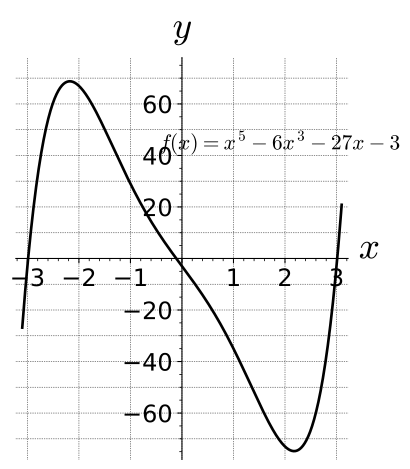
\(f(x)\) can have at most one maximum and one minimum. It is easy to show that
\(f(x)\) changes sign between
\(-3\) and
\(-2\text{,}\) between
\(-2\) and
\(0\text{,}\) and once again between
\(0\) and
\(4\) (
Figure 11.2.2). Therefore,
\(f(x)\) has exactly three distinct real roots. The remaining two roots of
\(f(x)\) must be complex conjugates. Let
\(K\) be the splitting field of
\(f(x)\text{.}\) Since
\(f(x)\) has five distinct roots in
\(K\) and every automorphism of
\(K\) fixing
\({\mathbb Q}\) is determined by the way it permutes the roots of
\(f(x)\text{,}\) we know that
\(G(K/{\mathbb Q})\) is a subgroup of
\(S_5\text{.}\) Since
\(f\) is irreducible, there is an element in
\(\sigma \in G(K/{\mathbb Q})\) such that
\(\sigma(a) = b\) for two roots
\(a\) and
\(b\) of
\(f(x)\text{.}\) The automorphism of
\({\mathbb C}\) that takes
\(a + bi \mapsto a - bi\) leaves the real roots fixed and interchanges the complex roots; consequently,
\(G(K/{\mathbb Q} )\) contains a transposition. If
\(\alpha\) is one of the real roots of
\(f(x)\text{,}\) then
\([\mathbb Q(\alpha) : \mathbb Q] = 5\) by
Exercise 5.4.28. Since
\(\mathbb Q(\alpha)\) is a subfield of
\(K\text{,}\) it must be the case that
\([K : \mathbb Q]\) is divisible by
\(5\text{.}\) Since
\([K : \mathbb Q] = |G(K/{\mathbb Q})|\) and
\(G(K/{\mathbb Q}) \subset S_5\text{,}\) we know that
\(G(K/{\mathbb Q})\) contains a cycle of length
\(5\text{.}\) By
Lemma 11.2.1,
\(S_5\) is generated by a transposition and an element of order
\(5\text{;}\) therefore,
\(G(K/{\mathbb Q} )\) must be all of
\(S_5\text{.}\) By
Theorem 9.3.4,
\(S_5\) is not solvable. Consequently,
\(f(x)\) cannot be solved by radicals.